INTEGRATED SCIENCE AND WATERSHED MANAGEMENT SYSTEM (ISWMS™)

Real-time, probabilistic flood and low-flow intelligence forecasting and mapping designed for operational decision-making at scale.

Unlike conventional hydraulic modeling workflows, ISWMS™ combines ML-based probabilistic forecasting with rapid mapping, reducing time-to-insight from weeks to hours.

  • Operational forecasts with uncertainty: supports real-time situational awareness and planning (including multi-scenario climate inputs where applicable).
  • Fast, actionable mapping outputs: translates flow forecasts and design flows into flood risk intelligence that can be communicated visually.
  • Built for complex engineering applications: supports infrastructure owners, emergency management, and resource/industrial operators.


Trusted since 1999 — Supporting operations for municipalities, conservation authorities, emergency management programs, and resource sector clients across Canada.

What ISWMS™ delivers

Modern watershed management requires forecasts that are not only timely, but also transparent about uncertainty and easy to act on. ISWMS™ integrates forecasting, hydrologic context, and mapping-oriented outputs to support decisions across flood response, drought/low-flow operations, and long-term planning.

Capabilities:
 
  • Probabilistic flow forecasts — localized, uncertainty-aware predictions
  • Flood and low-flow decision support — real-time operational view
  • Flood-frequency analysis (FFA) — return-period design flow context
  • Map-ready risk intelligence — web-ready visuals and decision outputs


Current platform capabilities


ISWMS™ v3 (Operational) — Machine-learning flow forecasting + FFA
 
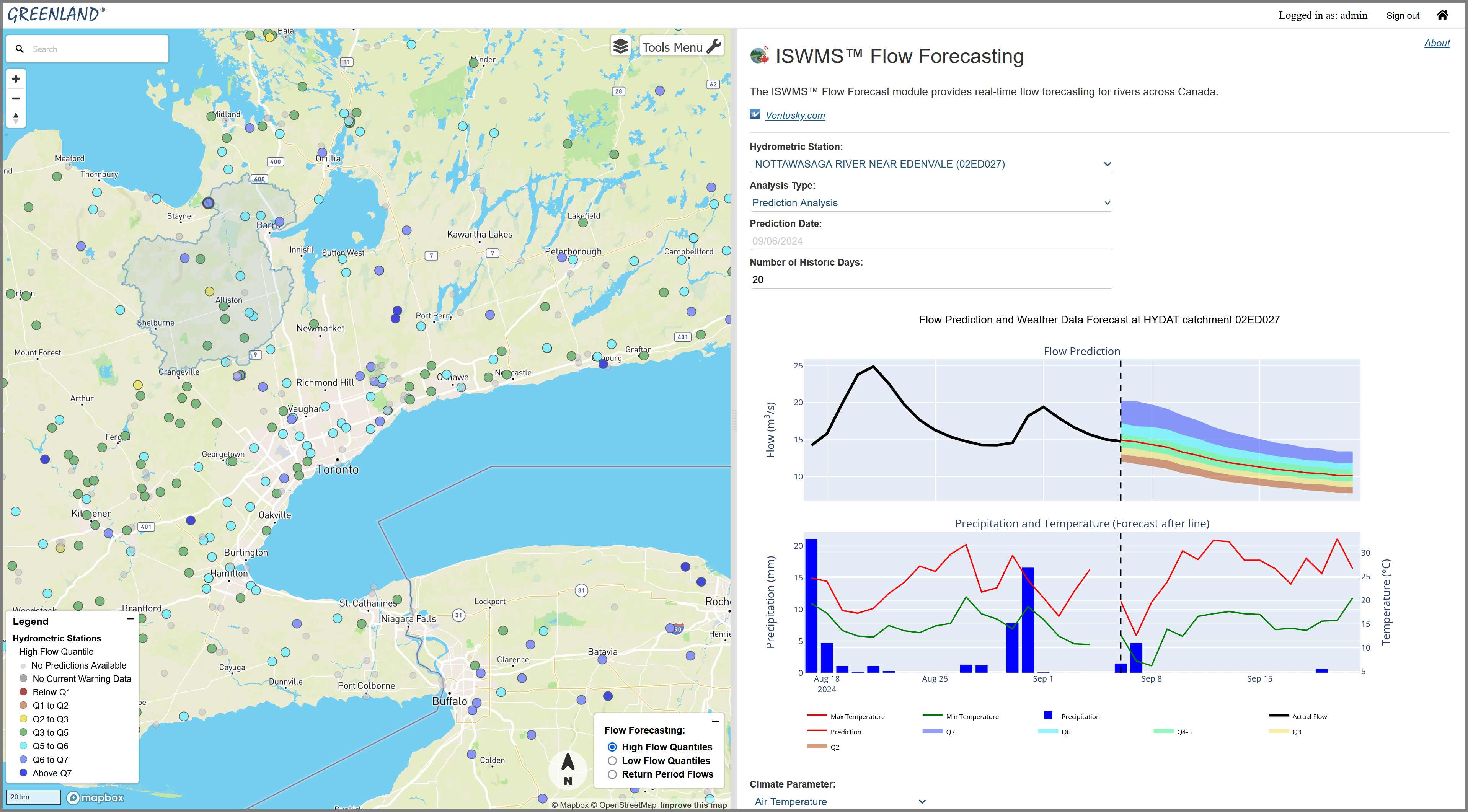
  • Incorporates a Temporal Fusion Transformer (TFT)-based machine-learning model to generate hydrometric flow forecasts across North America.
  • Trained on an extensive archive of flow measurements from thousands of gauging stations, integrating:
    • real-time hydrometric observations
    • climate inputs
    • catchment characteristics
  • Produces localized probabilistic flow predictions to support operational decisions.
  • Includes Flood-Frequency Analysis (FFA) functionality to derive return-period basin flows, enabling both real-time forecasting and long-term hydrologic design context. 

See ISWMS™ v3 video (with audio)

ISWMS™ v5 (Prototype / Pilot) — Rapid hydraulic flood mapping with LiDAR-informed modeling
 
  • Addresses a common gap: many regions lack up-to-date, decision-ready flood maps due to the cost and time required for conventional hydraulic modeling.
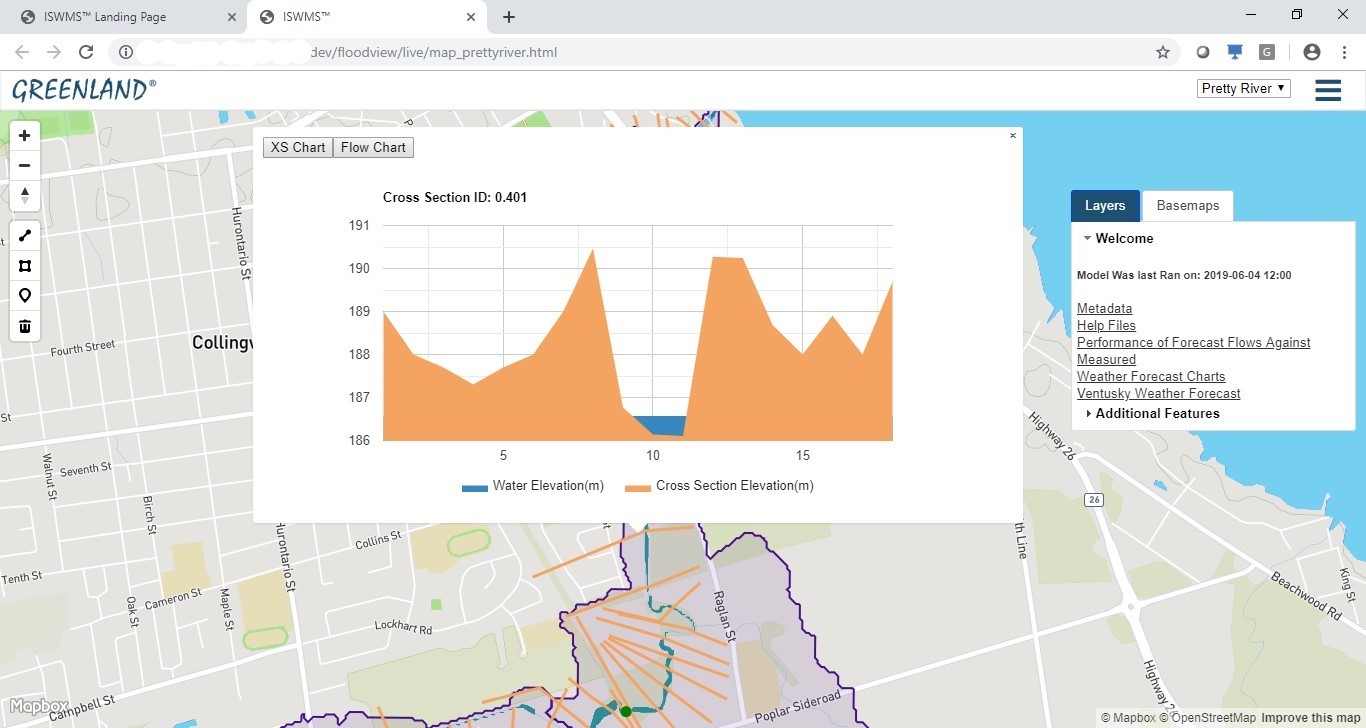
  • Adds a computationally efficient hydraulic flood mapping approach designed to translate forecasted/design flows into inundation extents that can be rendered in web-based map products.
  • Evaluated using a LiDAR-based open-source mapping database and assessed against a calibrated, validated, professionally sealed hydraulic model for a real river system context.


Validation and quality assurance


Validation highlights:
 
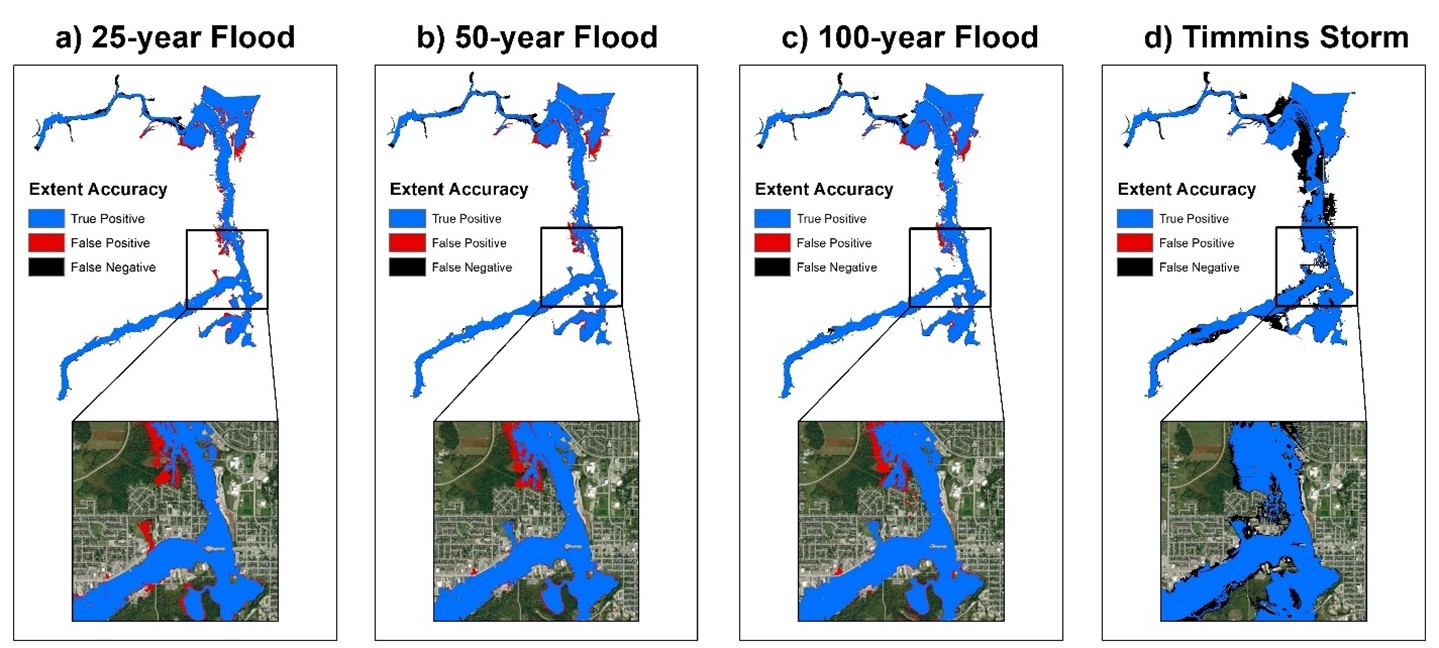
  • Where validated: Mattagami River system / City of Timmins, Ontario
  • Compared against: Calibrated, validated HEC-RAS 1D model sealed by a professional engineer
  • Events tested: 25-, 50-, and 100-year return period floods; Timmins Storm (regulatory) flood event
  • How evaluated: Flood extent comparison using 9 statistical performance measures
What this means for users: Confidence-aware outputs and decision support—not just a single deterministic line.

Limitation acknowledgment: Forecast skill varies by basin data availability and climate input quality. ISWMS™ outputs are decision-support tools and do not replace site-specific engineering assessments where required.


Applications

Resource and industrial operators (mining, oil sands, etc.)
  • Operational risk management for flood/erosion susceptibility affecting facilities, access routes, and site infrastructure.
Utilities + hydropower
  • Flow prediction for operational planning, asset protection, and optimization of hydropower operations.
Emergency management + public safety
  • Flood early warning and operational response support for vulnerable communities, including flood-prone settlements and remote regions.
Infrastructure owners and corridors
  • Risk intelligence for:
    • Wastewater treatment plants impacted by floodplains (including CSO storage/overflow contexts).
    • Road/bridge crossings and culverts supporting asset management programs.
    • Transportation corridors susceptible to flash flooding.
    • Pipeline/telecommunications crossings affected by erosion and extreme flows.
Consulting and planning
  • Support for environmental assessment planning and design for corridors and facilities; technical inputs that support stakeholder engagement contexts where required.


Deployment and governance
 
  • Designed to support operational usage with monitoring and controlled access.
  • Supports defensible workflows by documenting inputs, assumptions, and uncertainty.


To explore how ISWMS™ supports operational flood and low-flow decision support, contact us or request a demonstration.
 

Updated: January 7, 2026
Greenland International Consulting Ltd.


Social Media

 
LinkedIn 
YouTube

Client Testimonials

County of Simcoe

The County of Simcoe is the upper tier government and planning authority for most of the South Georgian Bay – Lake Simcoe Source Water Protection Region. The County, in partnership with its member municipalities, other levels of government, floodplain management agencies and two (2) conservation authorities, also provides leadership through policy, and actively in the restoration and protection of the environmental health and quality of these watersheds. As you know, in order to comply with, and be environmentally proactive with respect to the Province of Ontario’s “Places to Grow” legislation, the County of Simcoe utilized innovative decision support tools such as Greenland’s CANWET™ model. In 2012, CANWET™ was also used by the County to prepare a “Water and Wastewater Infrastructure Visioning Strategy”. To this day, the information in the Strategy’s final report is used by local municipalities, development interests and other stakeholders as a background reference to help identify sustainable development solutions.
 
This letter confirms the County of Simcoe's commitment of support which includes initially facilitating the introduction of this landmark international collaboration with all 16 local municipalities, other governments (small and large) and other agencies that partner now with the County of Simcoe on land use planning; infrastructure renewal; and flooding risk/damage reduction initiatives.
 
As always, I look forward to our continued working relationship with you and your colleagues and the significant benefits these efforts will have for our residents and environment. The County of Simcoe appreciates your efforts towards developing information based decision making tools and we are confident that this project will prove beneficial in our collaborative goal to improve watershed health for all County residents.

Mark Aitken
Chief Administration Officer
The Corporation of the County of Simcoe

October 19, 2015
 

City of Toronto

Mayor David Miller and Members of Toronto City Council extend appreciation to Greenland Group of Companies for your outstanding contribution to the City of Toronto’s Green Roof Technical Advisory Group. As a participant of the City of Toronto’s Green Roof Technical Advisory Board, you have contributed tremendously to its leadership role on climate change and helped support the development of the Toronto Green Roof By-law.

This initiative, the first of its kind in North America, sets the standard in designing sites and buildings across the city that are more environmentally friendly, a key strategy in reducing the effects of climate change.
 
We thank you for helping our city achieve its vision and goals on climate change – it is this kind of collaboration that makes us proud, prosperous and successful.

Best wishes for continued success.

David Miller
Mayor
City of Toronto

May 2010
 

Agriculture and Agri-Food Canada

In March of 2013, Greenland International Consulting Ltd. completed a study for Agriculture and Agri-Food Canada to estimate nutrient loading in small catchment of about 177 square kilometers in the La Salle River watershed in southern Manitoba using the CANWET 4 model. Given uncertainties in some input data and model parameters, the preliminary results using the CANWET 4 model for baseline conditions of stream discharge, nutrient concentrations and loads were satisfactory in our project team as simulated values were within the range of observed values during the validation period.

This study suggests the CANWET 4 modeling approach could be used to predict changes to nutrient loads from changing land use scenarios in watersheds of this region.

Jason Vanrobaeys
Senior Land Resource Specialist
Agriculture and Agri-Food Canada
 

Corporate Partnerships & Associations

Partnerships and Accreditations