GREENLAND® deliver s decision-grade watershed modeling and cumulative effects analysis through CANWET™—an advanced analytics platform supporting planning, infrastructure, and climate adaptation across urban and rural landscapes. Developed by GREENLAND® since 2003, CANWET™ combines open data workflows, GIS-enabled analysis, and high-performance computing to provide defensible, science-based insight for decision-makers responsible for watersheds, infrastructure systems, and climate resilience.
CANWET™ is "Powered by SWAT" (the Soil and Water Assessment Tool)—a widely recognized, peer-reviewed hydrologic and water quality modeling engine. The platform integrates an open-source GIS environment and decision-support analytics designed to inform watershed management; water supply and wastewater treatment infrastructure planning; urban drainage strategies (quantity and quality); and climate change adaptation. From GIS data inputs, the platform can calculate hourly water balance and related watershed parameters—including nutrients, erosion/sediment, bacteria indicators, water temperature, dissolved oxygen, and other key indicators—enabling robust scenario testing and transparent comparison of alternatives.
Decision support for planning, infrastructure, and climate adaptation
CANWET™ is used to support watershed and infrastructure decisions where stakeholders need to understand trade-offs, cumulative effects, and implementation practicality. The platform includes science-based climate change impact analytics and evaluation of mitigative Best Management Practices (BMP) and Low Impact Development (LID) strategies. CANWET™ also includes automated model calibration and verification capabilities to improve confidence in scenario results and reduce project effort—supporting more timely, iterative "what-if" analysis when decision timelines are tight.
Track record and applied use
Initial proprietary versions (mid-2000s) were completed by GREENLAND® with support from the Government of Ontario (Canada), including work associated with the award-winning Lake Simcoe Protection Plan. Subsequent updates have been applied by GREENLAND® in delivering client work across:
This practical, project-driven application has shaped CANWET™ to serve not only as a modeling engine, but as a consistent analytical foundation for comparing scenarios, supporting stakeholder engagement, and translating watershed science into decision-ready outputs.
Lake Erie nutrient reduction investigations (2015–present)
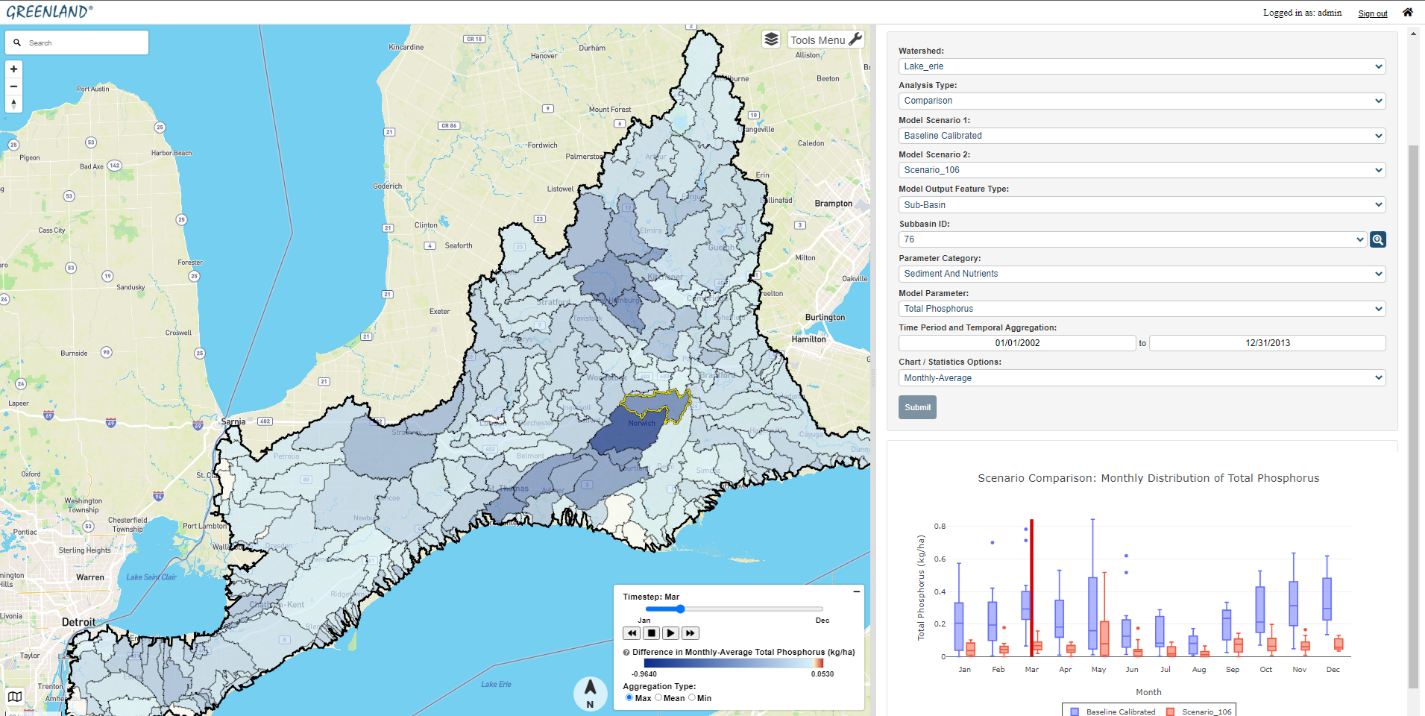
Since 2015, GRE ENLAND® and the University of Guelph (Canada) have collaborated to support watershed-wide phosphorus and other nutrient reduction investigations for the Lake Erie Basin, affecting Canadian sources draining to the lake. CANWET™ has been used to quantify and compare options and to help inform a wide range of policy and implementation pathways.
In 2018, the first Government of Canada publications reflected consideration of analytical work and findings prepared by GREENLAND® to help establish and evaluate a suite of viable options. Further confidential evaluations using CANWET™ were undertaken by GREENLAND® and later considered for the next publication update by the Government of Canada, including work in 2024.
The underlying analytical approach has examined policy and implementation options against criteria that decision-makers routinely require, including:
Additional Lake Erie work also assessed which initiatives were already in place and recommended how gaps might be filled. The objective was to determine what "best suite of policy actions" could achieve the greatest nutrient load reductions while also being effective in terms of cost, time, and social acceptance. A related analytical and stakeholder engagement approach applied CANWET™ to quantify and understand the origin and timing of nutrient loads from Canadian lands draining to Lake Erie.
AI/ML-enabled enhancements and broader accessibility
Following the pandemic, GREENLAND® initiated a longer-term collaboration with the College of Engineering at the University of Guelph to advance CANWET™ with Artificial Intelligence and machine learning features—maintaining core modeling capabilities while adding new predictive functions compatible with the SWAT analytical engine.
This collaboration has expanded the platform's accessibility and analytical reach. According to Professor Prasad Daggupati at the College of Engineering, University of Guelph: "The system can now be accessed by everyone—from government to urban planners and researchers working with the GREENLAND® team. Users can also see spatially what is happening and take appropriate actions."
Early applications of the AI-enabled functionality have supported participating agencies in efforts to reduce harmful effects associated with algal blooms and related water quality impacts within the Lake Erie Basin.
High-performance computing and web platform evolution
The latest version of CANWET™ advances earlier desktop implementations by leveraging high-performance parallel (cloud) computing. The current version includes a fully functional web-based platform with SWAT modeling tools designed to expand access for decision-makers and stakeholders, and to advance cumulative effects evaluation as a practical component of watershed decision-making—rather than assessing proposed changes only in isolation.
Since 2015, CANWET™ has taken advantage of high-performance computing by porting existing code to a higher performing language and restructuring it for parallel or multi-core processing. These enhancements have delivered dramatic reductions in simulation runtimes. Reduced runtimes also enable the use of automatic calibration and verification routines for SWAT model setups, supporting lower project labor costs and enabling faster turnarounds for scenario testing—including when stakeholders request additional re-runs through the web interface.
Looking forward: broader decision support across Canada
CANWET™—as a web-based, machine learning–enabled platform powered by SWAT—can support a broader set of decision-makers and policy leaders in Canada by improving understanding of pollution sources and climate-driven risk factors, and by enabling more efficient evaluation of watershed-scale BMP suites.
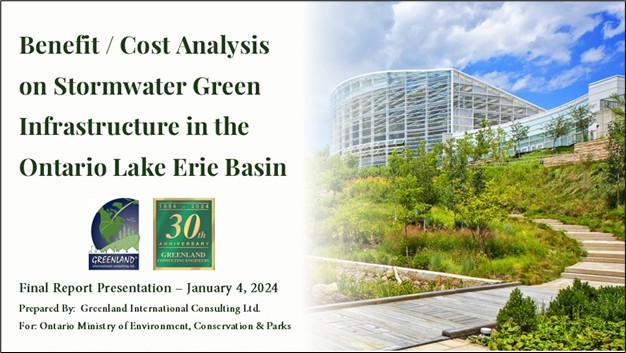
As an example, in January 2024, GREENLAND® completed a related project for the Government of Ontario using CANWET™ to deliver a Stormwater Green Infrastructure Benefit/Cost Analysis for Lake Erie Municipalities. The approach and technology were intended from the outset to be transferable to other Ontario municipalities.
As of December 2025, consultations have been underway involving GREENLAND®, the Federal Government, and Canadian Provinces regarding further use of CANWET™ (and in combination with THREATS™) to support additional public-private collaboration opportunities of mutual interest.
To discuss how CANWET™ can support your watershed planning or infrastructure decisions, contact us or request a platform demonstration.
Updated: January 7, 2026
Greenland International Consulting Ltd.
______________________________________________________________________________


County of Simcoe
Greenland provided exemplary consulting services to complete this landmark project. The firm’s attention to detail and proactive ideas was very important to assist the County in addressing the issues of concern about the study’s findings and also providing defendable, yet provocative, solutions based on best available science and proven technologies for the benefit of all local municipalities.
This letter confirms that the study objectives were met within the approved time frame. Greenland also provided a sizeable in-kind contribution to complete value-added deliverables and established new partnerships in terms of future watershed modeling and technology development initiatives involving the County of Simcoe.
Rick Newlove, P. Eng.
General Manager of Engineering, Planning and Environment
County of Simcoe
May 1, 2012
City of Ottawa
On behalf of the City of Ottawa, we would like to thank Greenland International Consulting Limited, and in particular, Don Moss for his exemplary efforts in his role as Model Keeper for the City of Ottawa… Greenland has achieved a high level of confidence with Senior Staff and City Council as well Conservation authority and the Ontario Ministry of Environment… The City is appreciative of the new Modelling Tool developed by Greenland which will assist the City in conducting timely and efficient development reviews. The City will now be able to test proposed infrastructure with the overall development, determine changing impacts to existing infrastructure as ponds, as well as any changes to the receiving watercourses.
Don’s knowledge, dedication and professional approach over the past five years has been a crucial factor in the success of the project under very challenging circumstances.
Don Herweyer, MCIP, RPP
Program Manager
City of Ottawa
February 11, 2014
Cortel Group
Greenland and Dr. Goss also played an important role in identifying issues with the initial study proposal.
This led to the Province and Williams Treaty First Nations reaching a resolution based on manageable terms.
With thanks,
Elsa Fancello
Project Manager
Cortel Group (Vaughan, Canada)
November 20, 2024